English
 Italiano
Clovis & Giornale Della Vela
Giornale Della Vela, February 2019
I live on a boat, and I will reveal all my tricks (of sailing and fishing)
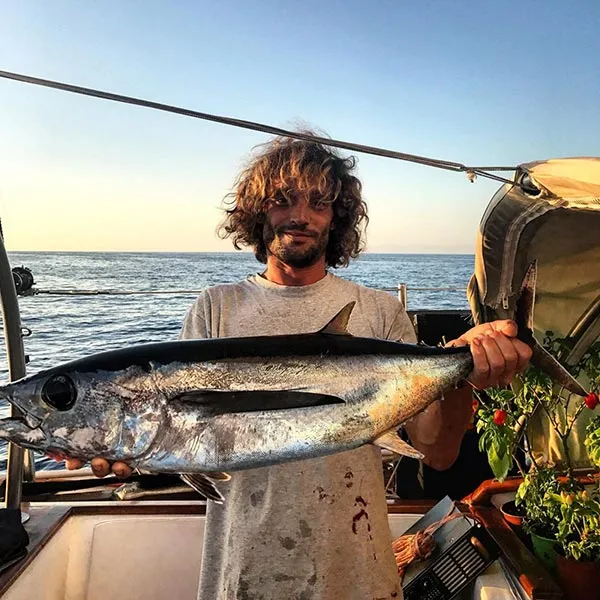
Good morning everyone, it is only right to begin by introducing myself. I am Riccardo Fracchia, with my talents and my flaws. The flaws you will get to know over time, and the few talents I will tell you about right away: first a sailor, second a great fan and reader of Giornale della Vela, and third a lover of boats, the sea, sailing, nature, fishing, mechanics, cooking and navigation. In short, nothing special, because these are all things that you like too. Lastly, and this certainly does not count among the talents, it is fair to say that I am the captain and owner of Clovis, a boat that is very special to me: since ’97 she has been a second mother and a great school of life, as well as the means that allowed me to refine and cultivate all the passions listed above. That is why I am here to write and talk about the sea with you, the sea in all its aspects: what it is, what it offers and the splendid and important activities that take place on it. Before starting, it is perhaps fair to say that everything I will tell you in the following lines, this month and in the months to come, is not simple theory learned in various biology courses or by attending a seminar, nor even just the fruit of the precious exchanges on board with biologists, scientists and scholars. Or rather, it is not only that; I will tell you about my personal experience as someone who lives the sea in every aspect, 365 days a year.
Because “we”, my partner Marika and I, have now spent 1500 days living all year round on Clovis, our beloved aluminium mother with her two mighty masts, trees without leaves. Living on the sea, with it and thanks to it, through all the seasons that our precious hemisphere can give us. These stories of mine are the fruit of the experience of someone who moves with the wind not only for pleasure, but also as a life, a choice and a job, accepting to move according to the events and the weather that the great blue proposes and imposes. Fishing and cooking when the sea allows it and living every day with the relentless wear of sun and salt, but staying afloat all year long. So, bringing the long preamble to a close… let’s talk about the sea! I will start my story from today, at this very moment, 23:26 on Wednesday 6 March 2019, at coordinates N38°43.58 E1°.24.56, the exact position where we are with our good Clovis inside the well sheltered port of Formentera. Right now there are 20/22 kts of wind from the southwest, which is the prevailing wind direction in the winter months, exactly the opposite of the fresh, dry northeasterly that blows in the summer months. That very Grecale which is a small slice of the powerful wind born in the Gulf of Lion under the name of Mistral. Three quarters of this mighty, cold wind beat down on the western coasts of Sardinia, reaching and compressing into the Strait of Sicily and heading in the direction of the Scirocco. Here in the Balearic archipelago, instead, it changes: the compression of the wind in the feared Gulf of Lion pushes part of it towards the warm land of the islands, and a slice of it heads SW, towards Libeccio. This wind, laden with the cold of the Tramontana (trans montes), after passing over the icy Pyrenees, crosses the magical headland of Cap de Creus, home to a splendid lighthouse and a mystical seaside town by the name of Cadaques; from here this air flies over the temperate sea and little by little grows milder. It reaches the Balearics, first striking wild and exposed Menorca with force, then wrapping around the large Mallorca and arriving as far as the smaller and more distant Ibiza and Formentera, where it is gentler and keeps the pleasant character of a fresh breeze that caresses the islands.
From May to October this summer wind invites splendid sails during all the hours of thermal breeze, and on some days it is so strong that it lets us play a little with reefs and jibs. But this is not the time to talk about meteorology. I would like to tell you about the activity that, together with the maintenance of our demanding boat, has filled my winter days and nights: fishing. Since ancient times, fishing has certainly been one of the activities that allowed mankind to grow, feed itself and develop over the millennia up to today. Or rather, up to yesterday, because for a few decades now, as we can all see, fishing has become an industry that is not aimed at feeding people but only at making enormous profits, with very little regard for the environmental damage it can cause. Talking with many fishermen over the years (people who have fascinated me deeply since I was a child for their way of life and their tough hide), I have often been told that in many cases, or rather in several kinds of fishing, for example trawling practised in certain places and at certain depths within the limits prescribed by law, enormous damage is done. Between 20 and 40% of the fish caught has no market and, because of its type, size or condition, is thrown back into the sea, obviously lifeless.
Secondly, just think of our supermarkets and large fishmongers, which buy a great deal of catch from our sea and from distant oceans; they increase demand and, as a consequence, fishing. All this just to fill cold counters that must have a wide offer and choice of fish, as if it were a vegetable grown in a greenhouse or an item produced on an assembly line. But unfortunately that is not how it is: many rare and prized fish, which are valuable in the most important markets and are used in the delicious dishes of exquisite restaurants, live and hide in places and stretches of sea that are deeply violated in order to catch them. After talking to many of those directly involved, I was told how much of this catch has to be thrown away after 3 or 4 days, or in some cases after 5 or 6, because it is no longer in a condition to be sold. I say this only because I have been fishing since I was very small, first with a simple fixed rod at the age of 4 or 5, then moving on to the more advanced rod and reel, until ten years ago, when I was fishing from the beach or from the boat with at least 5 rods at the same time. This has allowed me to see how deeply our sea and our fish have changed over the last 20 years, and with spearfishing I have learned to notice how, over time, even the behaviour of the few remaining fish, which are frequently hunted, has changed. Coming back to us, I am very passionate about some fishing techniques, while others I have never considered or tried, perhaps because of the great satisfaction I get from the methods I love most, or more probably because I find them in some respects invasive, and in a few cases even unfair.
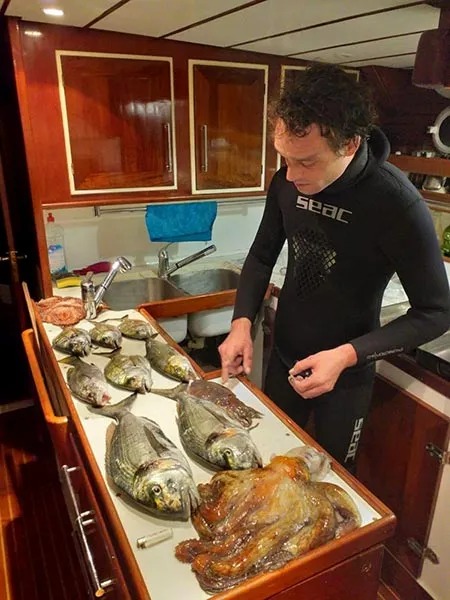
We will not, in fact, moralise in any way about certain techniques, since everyone chooses what they want. Provided that the fishing is conscientious, taking into account and observing the various parameters that can help the novice fisherman, or even worse the expert one, not to damage or impact the environment. These precautions are to be used and adjusted according to the season, the place, the prey we want to target and the type of fishing we have chosen; it will be important to know the local laws and the rules of the sea, and so to take into consideration the size of the hooks, the hours and duration of fishing, the breeding periods of the various species, the bait used, the place and the time of year, the moon and the tide, the currents and many other important variables. The fishing techniques I practise most often are coastal trolling, bottom fishing and bolentino, and fast offshore trolling. The techniques I love most, on the other hand, are the longline in all its forms, whether deep for bottom fish and gilthead bream, or with floats for sea bream, all the way to open sea longlines with buoys and large hooks for tuna or swordfish. But perhaps the one I love most, and the one that ties me most closely to the marine environment, is spearfishing while freediving, whether with the ambush technique or lying in wait, for as long as my lungs allow. Then deep trolling with live bait (squid, garfish or horse mackerel) to catch precious fish such as dentex, amberjack or large red porgy. The technique I have carried with me since I was a child, and to which I now devote less and less time, as I said before, is surfcasting, from the beach or from the rocks with 3 or 4 well equipped and well positioned rods. So I cannot wait to tell you everything I know, and to learn from you everything I am missing. I say goodbye for now and look forward to seeing you in the next episode, ready with a few photos to chat with you about fishing in our beloved and little respected Mediterranean.