English
 Italiano
Clovis & Giornale Della Vela
Giornale Della Vela, August 2019
Fishing while you sail (and more)
With spring, the first rains and the first heavy seas have arrived. Land and sea begin to change as a result, the first colours come out and the fish fully resume their life cycle. And this is exactly the best time to practise, with good results, a few fishing techniques that, if done well, can bring us to sit with our legs under the cockpit table enjoying some gift from our Mediterranean. During spring and early summer we find very similar sea conditions along the Italian coasts: temperature, tide, moon phase and other parameters remain almost unchanged from north to south, while the spots, the prey, the currents and the local baits will vary considerably.
Fish? Do not underestimate their cunning
A necessary premise: fish. Apart from the small ones and a few particular species… they are not “stupid”! On the contrary, luckily for them, they are far quicker and smarter than we imagine: I have had ample proof of this on many occasions. They perceive smells, noises and movements with infinite sensitivity and, as they grow, these qualities improve and sharpen. So, starting from this assumption, it is important not to underestimate the cunning of our prey, whatever it may be and whatever technique we use to go after it.
All the secrets of coastal trolling
If the weather allows it, it is great fun to practise coastal trolling during short daily passages and offshore trolling during longer ones. In the first case, close to shore, you can use small Rapala lures or weighted spoons, but I prefer to fish the way good old Salvatore from Lampedusa (uncle Salvo) taught me, using eight or nine small feathers with a sparkling spoon at the end. Each feather hides a sturdy size six or size four hook, depending on the size of the fish found in that stretch of coast. You can buy them or make them yourself. Salvo made exceptional ones using a particular red and black braided line and the bristles of a brightly coloured nylon broom that he stole from his poor wife; I use the various materials available in the endless storeroom of Clovis.
Secondly, just think of our supermarkets and large fishmongers, which buy a great deal of catch from our sea and from distant oceans; they increase demand and, as a consequence, fishing. All this just to fill cold counters that must have a wide offer and choice of fish, as if it were a vegetable grown in a greenhouse or an item produced on an assembly line. But unfortunately that is not how it is: many rare and prized fish, which are valuable in the most important markets and are used in the delicious dishes of exquisite restaurants, live and hide in places and stretches of sea that are deeply violated in order to catch them. After talking to many of those directly involved, I was told how much of this catch has to be thrown away after 3 or 4 days, or in some cases after 5 or 6, because it is no longer in a condition to be sold. I say this only because I have been fishing since I was very small, first with a simple fixed rod at the age of 4 or 5, then moving on to the more advanced rod and reel, until ten years ago, when I was fishing from the beach or from the boat with at least 5 rods at the same time. This has allowed me to see how deeply our sea and our fish have changed over the last 20 years, and with spearfishing I have learned to notice how, over time, even the behaviour of the few remaining fish, which are frequently hunted, has changed. Coming back to us, I am very passionate about some fishing techniques, while others I have never considered or tried, perhaps because of the great satisfaction I get from the methods I love most, or more probably because I find them in some respects invasive, and in a few cases even unfair.
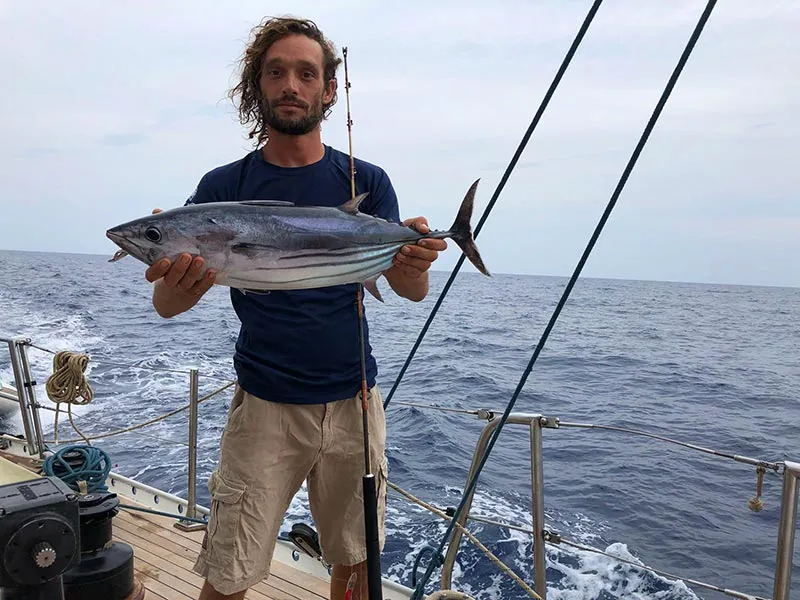
These hooks are tied one to two metres apart on the main line by means of short, sturdy snoods that give the feathers a natural movement while preventing them from sliding along the line when a fish bites. This rig is to be lowered into the water between 40 and 600 metres from the coast and paid out astern. When the last of the 10 hooks (the one closest to us) is in the sea, we let it out between 40 and 70 metres from the stern. This tackle is towed at 3 or 4 knots, or a little more, moving it constantly by hand, pulling it in by an arm’s length and letting it go so as to simulate the acceleration of a small fish fleeing from a predator. Always point the bow of the boat (or better still, of the tender) towards the seagulls flying in a group and circling above a precise spot, or follow the signs of fish jumping to escape predators. In this way it will be easy to catch small, voracious amberjacks, the increasingly widespread and numerous sea pike (a kind of Mediterranean barracuda) and little tunny, the ones I call sea chickens because of the resemblance of their meat, and the same ones that are so good preserved in oil for the late summer week with friends or, better still, on the table at home during the winter.
Offshore trolling
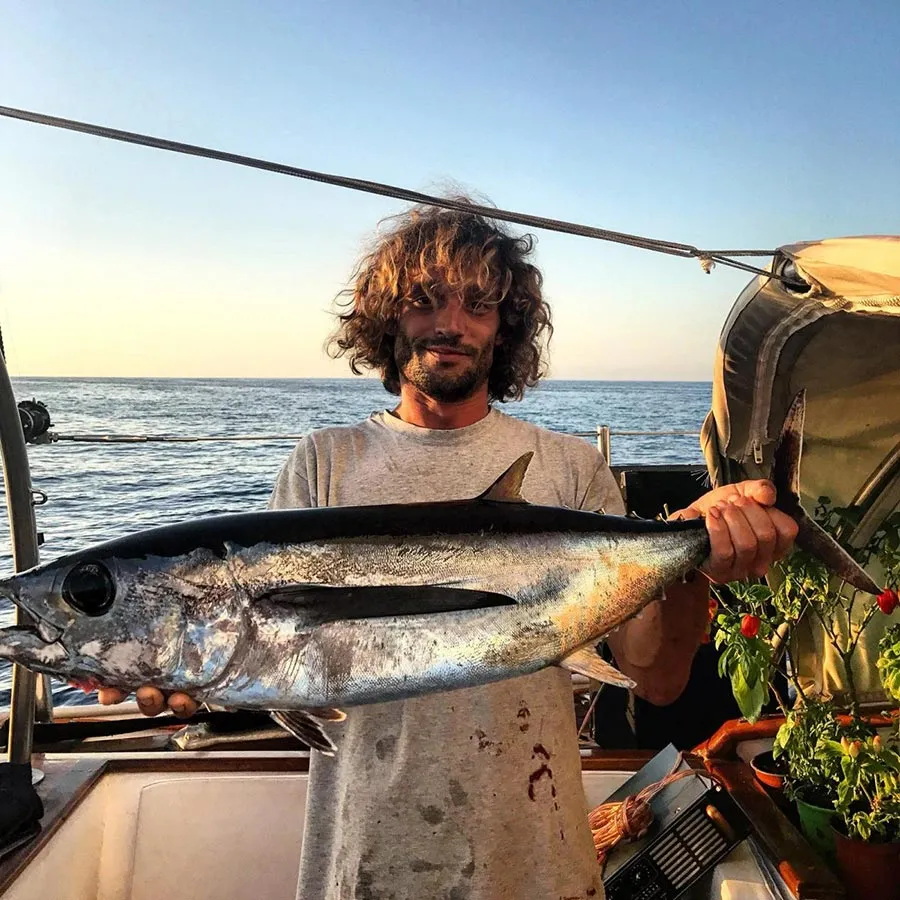
Offshore trolling, on the other hand, is a different matter altogether, first and foremost for the speed, which varies between four and eight knots, and for the size of the lures, which increases considerably so that large fish can see them and feel the turbulence they create more quickly. Sailing many miles every year (with Clovis we covered more than six thousand in 2018), I would be truly foolish not to tow a couple of lures, whether I am under sail or under power. So over time I have tried them in every colour, style and size. By now I have a faithful and legendary ally that is always my favourite choice in any weather and at any speed: the 14 cm red head Rapala, to which I add a cigar shaped weight of 80 to 120 grams, held in place by a stainless steel swivel with a knot protector ten metres from the lure, to help it sink and to create air bubbles that intrigue the fish. I leave the first of the two rods, rigged identically, 80 metres astern in the wake and the second at 150 to 170 metres, outside the turbulence created by the propeller. With this technique I have had great catches and great satisfaction, in some cases in such abundance that it clashed with my principles. I have often forced myself to limit my fishing, because the needs of the boat for the entire week were covered by a few minutes of fishing in the right place. Large dolphinfish, big bonito and tuna of various species have attacked our lures: whenever the fish met the parameters of nature and of the law… species, size and season… it was immediately cooked according to our on board recipes and eaten in good company!
When you cannot sail: surfcasting
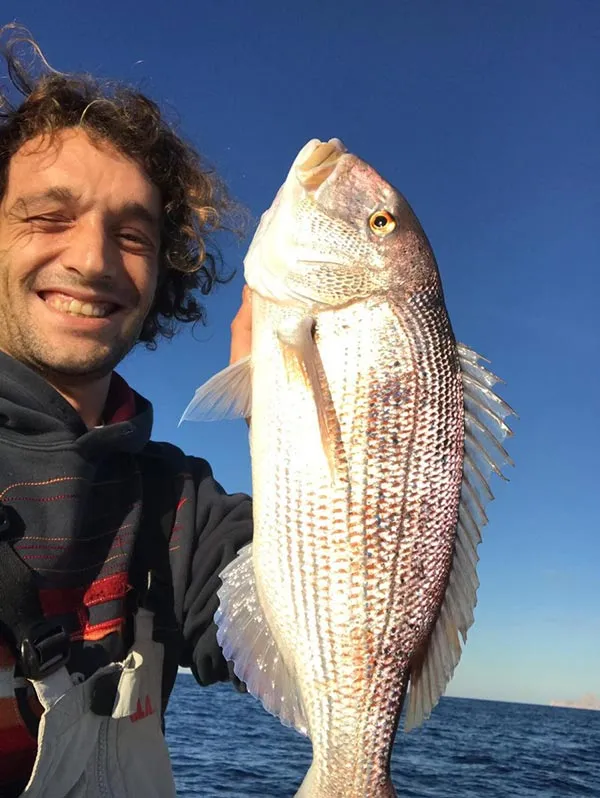
One of the techniques I have practised the longest, ever since I was a child, and which has given me some fine satisfaction over time, is surfcasting. I always practise it in strong wind and rough seas, in other words when you cannot sail and may be forced to stay put, or on the few occasions when I am not on board or near Clovis, where I keep all my gear for every fish and every kind of fishing. This is because, like spinning, it can be practised with little equipment and from land, comfortably from the beach or from the rocks, during your cruise. I always use three identical 4.20 m rods, fitted with large reels able to hold a lot of line and retrieve plenty of it with each turn of the handle. Depending on the prey and the place, they can be rigged in two different ways according to the position of the heavy sinker, which can be above the hook, sliding on the line, or at the end, with the hooks on the main line. Hooks, lines, sizes and thicknesses are calibrated according to prey, bait, strength of the current and clarity of the water: proportionally, the stronger the current, the shorter the snood, and the clearer the water, the finer the line must be, always keeping a proper balance with the size of the bait and of the fish we want to target. A very important precaution is to handle all bait after washing your hands thoroughly with sea water, to remove the smells of food, detergents or, even worse, the strong smell of tobacco that lingers on smokers’ fingers. In surfcasting from the beach or from the rocks, different baits are used: worm or prawn for striped bream and sea bass at night, and whole mussel or crab for large gilthead bream during the day… with this technique we can fish on all those occasions when the sea keeps us in port. The prey may vary, but with this technique you will mainly be going after (delicious) white fish.